Public Sector Transformation
Digital Transformation in Public Sector: From Vision to Execution


Public sector digital transformation is not a technology project. It is an execution discipline. The leaders who succeed are the ones who turn vision statements into predictable delivery across agencies, vendors, and citizens.
Why the world is investing heavily in digital government
The UN notes that global E-Government Development Index (EGDI) scores have risen, with the global average improving from 0.6102 in 2022 to 0.6382 in 2024, but progress is uneven and the digital divide remains a challenge.
Singapore, for example, ranks among the world leaders in the UN E-Government Survey 2024, demonstrating the benefits of a sustained whole-of-government approach: consistent platforms, strong service design, and trust built over time.
The World Bank GovTech Maturity Index (GTMI) framework is useful because it forces governments to think beyond websites. It looks at four focus areas: core government systems, online public service delivery, digital citizen engagement, and GovTech enablers like strategy, institutions, skills, and laws.
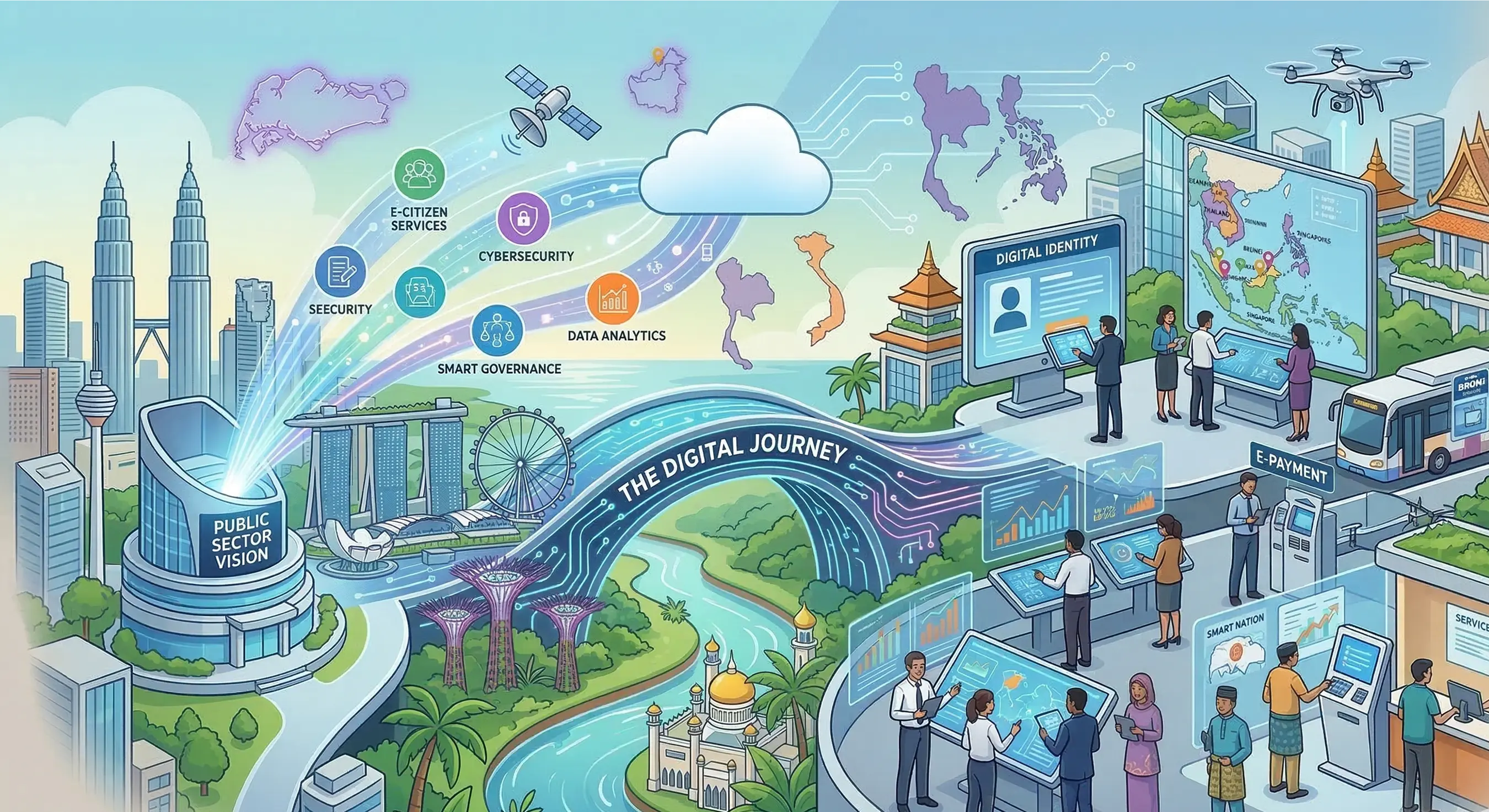
Brunei’s position and what it tells us
Brunei Darussalam now sits in the Very High EGDI group, with a rank around the mid-70s and an EGDI score around 0.755. This is a solid signal that the country has built foundational capacity.
Where most governments struggle is not the initial tech buy. It is the step after: interoperability, reuse, and continuous delivery.
Brunei has already identified major flagship initiatives that are exactly the right direction: a National Information Hub for secure data sharing across government, a Digital Payment platform, and a Digital Identity platform (including a Government SuperApp concept). These are foundational “whole-of-government” assets.
The execution challenge is making sure these assets become reusable building blocks, used consistently across ministries and agencies, instead of becoming isolated projects.
Across leading examples, three patterns repeat:
- Build reusable building blocks, not one-off systems.
GovStack promotes a building block approach with foundational components like identity verification, payments, consent, registries, messaging, workflow, and more. When a government has building blocks, it can deliver new services much faster. - Design around user needs and measure outcomes.
The UK Government Digital Service principles start with user needs, do less, design with data, and make things open because openness improves quality. Without service design discipline, digital services become digital paperwork. - Invest in GovTech enablers just as much as delivery.
Strategy, laws, procurement, skills, and institutional ownership matter as much as the portal itself.

Suggested improvements for Brunei
Here is how Brunei could convert vision into execution with less waste:
- Service clusters and modular delivery
Create 6 to 10 priority end-to-end services that matter most to citizens and businesses, such as licensing, permits, social benefits, healthcare access, and business registration.
For each cluster:- Define the service outcome, not the software feature list.
- Map the workflow across agencies.
- Use common building blocks: identity, payment, consent, messaging, and workflow.
- This reduces duplication and improves time-to-delivery.
- Make the National Information Hub the default integration fabric
The National Information Hub already exists to enable secure data sharing. It should become:- a mandatory integration point for new systems
- the place where common data models and APIs are published
- the platform that enforces consent and auditability
- Procurement and vendor management geared for continuous delivery
In many governments, procurement is optimized for hardware and construction projects, not software lifecycles. For digital services, the contract must encourage iteration:- shorter phases
- clear delivery increments
- performance and security non-negotiables
- vendor accountability for interoperability
- Relentless focus on adoption and trust
Digital identity, payments, and data hubs are only useful when citizens and businesses trust them. Trust is built through:- visible cybersecurity posture
- clear privacy controls and consent mechanisms
- transparent incident response and continuous monitoring

A suggested execution blueprint
A simple but effective blueprint:
- Set a small number of measurable outcomes per year (not hundreds of KPIs).
- Standardize building blocks and enforce reuse.
- Empower a central GovTech-like function to set standards and support delivery.
- Run cross-agency delivery squads for the top service clusters.
- Publish open APIs, documentation, and feedback loops.
- Review and reduce legacy systems over time.
The opportunity for Brunei
Brunei has a strategic advantage in scale. Large countries need enormous coordination; Brunei can achieve interoperability and common platforms faster if it commits to reuse and disciplined execution.
The country already has the right flagship ideas: identity, payment, and shared data. The next phase is making those platforms “boring,” reliable, and reused everywhere, so digital transformation becomes a predictable delivery engine rather than a collection of projects.
.webp)
.webp)